Introduction
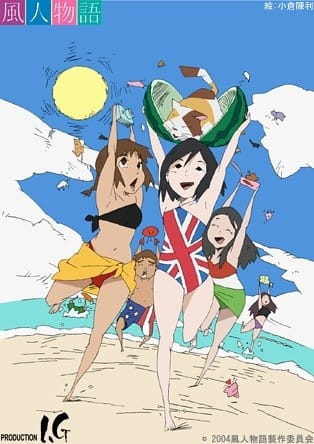
Nao, an 8th grader, is one of the only two members of a Digital Camera Club, where she also serves as the manager. It's a mystery that she shoots nothing else but the skies and clouds. One day, she finds a cat on a rooftop where she usually shoots her camera. It's a cat that knows how to manipulate the flow of a wind. Shocked to find a strange animal, Nao loses her footing and falls off from the rooftop!
Miki is the other member of the club, and also Nao's best friend. Mr. Taiki is the teacher who's taught the cat how to manipulate the flow of a wind. Ryoko is a girl who has a huge crush on Mr. Taiki. And there's Jun, who helps Nao and Miki look for a cat that can fly. Then, there's Yukio, who is the widow of Mr. Taiki's deceased brother.
On the outskirts of this big city, a town off the "Wind Handlers," has been formed—and a mysterious Wind Festival is about to begin...
(Source: Production I.G)
Audience reviews
11 · Sample from the first available page, separate from the total number of ratings.
Quaggy
If I were to give a basic synopsis of Windy Tales, I'd describe it as a simple down to earth slice of life story about maturing, photography, and the wind. All of this culminates in a uniquely ephemeral and dreamlike feeling. Often a feeling as if a strong gust of wind could sweep you off your feet and whisk you far into the sky. This strange and specific atmosphere conjures such a rare emotion I don't often feel that is hard to pin down. Windy Tales puts the viewer in a melancholic trance and leaves you with a certain warm fuzzy feeling in the end, not unlike a lot of other SoL anime, simply much more subdued and grounded.
Additionally, there is much more complexity underneath the feeling of nothing of note happening. This complexity is executed in a quite realistic way with lots of subt…
Read at the sourcerooster_
Windy Tales is one of those offbeat, pensive, largely un-marketable shows that filled out timeslots and release schedules for anime distributors in the 2000s, when the Western anime boom encouraged them to localize anything they could get the rights to. It's about as far as one can be from the battle shounens, shoujo rom-coms, and loopy gag shows that dominated that decade. A largely episodic story about a group of schoolgirls who discover a secret ability to manipulate wind, this unexpected superpower is introduced into an otherwise un-fantastic world, albeit one with healthy amounts of whimsy. As the characters enter their last years of school, this "wind in the heart" serves as a symbol for untapped potential and childhood innocence (which most users lose at a certain age, but some rare…
Read at the sourceGsarthotegga
In recent years, people have made a habit of complaining about how a "moe" aesthetic has taken over anime—not Moe Dalitz or one of the many characters named Moe from old American noir films or restaurants emblazoned with Eat at Moe's, but that kind of vaguely defined notion of generic trash anime with cutesy female characters to dote on, and the main attraction seems to not be story, animation, or artistic qualities, but arguing over who is the best waifu or has the best feet of the season or something. Okay, I actually don't know what moe is. It's just something for elitist whiners to complain about. Probably...
Anyway, it's likely best embodied in the usual output of the kind of anime labeled as "cute girls doing cute things," and those usually belong to the slice of life genre, where…
Read at the sourceN44K00
One of the examples given in the opening of the 2nd Plateau of ATP is the nature of a multiplicity, done by describing the nature of speed. Speed is topological in nature, it changes only be degree, by quantity, never by quality, being indivisible. All these multiplicities described are this way, changing only in degree, differences in kind only emerging from that. What is changing in degree in all of these is motion, some level of motion. This is the nature of wind as well, with "wind" not being so much an entity encapsulated like the word claims to, but instead being a motion across the atmosphere caused by a variety of factors. Such is the nature of wind in this show, an extremely powerful contemplation on this very idea and its magical and practical applications. In the twelfth episode…
Read at the sourcesyncrogazer
"I hope they didn't get too excited, soaring on these winds and drifting away, drowning... Sometimes, they drown in the sky and are lost. Just like people get swallowed by the waves."
Fuujin Monogatari is an example of an anime whose aesthetic is so well cultivated that its main theme, wind, is represented in every aspect. The rough, have seen it described as "draft-like," art; the music and sound design, the visuals, character designs and story-lines will all remind the the viewer of wind. Not just the idea of wind but the experience of it.
The creators of this show seemed content to be suggestive rather than overt in their exploration of this theme. This works out very well for the show, especially the way they handled the fantasy elements. As fantastical, and strange, as they are the…
Read at the source_Arcadia0
Fuujin Monogatari (Windy Tales)
Having just finished Windy Tales, I have no idea.... what I just watched. A slice of life about 2 girls who learn to manipulate wind. Miki and Nao are best friends who are apart of the Digital Photography Club. Nao loves to take pictures of the sky or rather, the clouds and the wind. Through this Nao and Miki discover a girl who can manipulate wind, Ryouko; she tells Nao how she too, can learn this ability. Flying cats are involved too and they really set the story in motion.
The story, if there is one, is either too deep or metaphorical for me to understand, unfortunately I'm not so good at picking things apart and trying to understand deeper meanings of a show, so to me, Windy Tales was a very nice, slow slice of life anime.
I really liked the art style…
Read at the sourceghosts-forever
Windy Tales is a slice of life anime. It doesn't try to be anything more or less than what it is, and that is what makes it shine.
As a slice-of-life, Windy Tales premise is relevant enough in each episode to create interest, but doesn't overshadow the stories themselves. Although the main characters learn about moving the wind to their advantage, we don't see them use it to fight evil or get what they want. Instead we see them go through their day to day lives WITH this power. The power to move wind isn't the main plot, the characters are. Personally, I found this to be a breath of fresh air. When a show has characters with powers, we don't think of slice-of-life. Instead we think of shonen anime, magical girl anime, adventure anime, anything BUT slice-of-life. Rarely is it we get to see…
Read at the sourceNavyCherub
Slice of life as a genre has a small problem. By itself, there is not much to base an entire show on – there has to be some sort of focus, a setting or concept that allows for individual stories to exist while also providing a solid base that pulls all of the ideas together. Fuujin Monogatari takes its identity as an episodic slice of life show to heart, almost to a fault – the individual episodes contain themes and ideas that are usually interesting and sometimes even compelling, but there is just about no connection between episodes thematically. The consequence to this is that Fuujin Monogatari is a show of widely varying quality.
Not to say that there is not a string tying the show together, loosely at least. That string is the titular wind, which the main characters (among others) ca…
Read at the sourceTien
Fuujin Monogatari, or Windy Tales, was a real treat to watch.
It's a very experimental anime, which is a rarity in the slice of life genre. Right off the bat, one will notice that the art style is seemingly messy and hastily drawn. In fact, it could even be called ugly. However, I found that it complemented the wind element of the show and meshed quite nicely with the animation. What struck me most about the art were the character designs: those tiny hands and feet, as well as those angular eyes that give the characters a distinct Asian appearance. I was also impressed by how highly expressive the characters' faces were. Joy, surprise, and even fear were depicted very effectively, despite the rather simple facial features of the characters.
Wind is the primary element that drives Fuujin…
Read at the sourceSneha
Wow, if ever an anime can leave me speechless, this would be it. The reviewer before me has done such a good job that I really don't stand a chance now do I? lol I'm just going to add that this anime has the most beautiful score I have ever heard. No it's not everyone's cup of tea (I know the animation style can put many people off; though personally, I find it cute and very interesting), but honestly, I could watch it without visuals or words - the music is just that captivating. So go on, if you're in the mood to watch something intriguing that will leave you feeling calm and strangely content, check this out. It's no masterpiece, but maybe it will have as special and mysterious an effect on you as it did on me..
Read at the sourceKopanda
First off I will admit that I am softy for Slice of Life series. My top five anime series are all about teenage girls exploring day to day life and Windy Tales (Fuujin Monogatari) is one of them.
Immediately the unique animation style struck me. Why is a story about a high school girl who likes to take pictures of clouds drawn in such an obscure way? The animation at times accentuates certain features we would not normally notice and obscures other features making the characters look a part of their environment. Whenever I see pictures of Windy Tales I get overjoyed, they satisfy ever corner of my eyes as normal anime characters don't. There's no sparkle in their irises or shiny wetness to their hair, they look sharp, drawn and fit like puzzle pieces in the background. I see this more as…
Read at the source