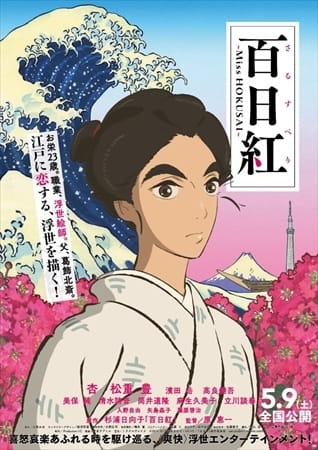
Introduction
The time: 1814. The place: Edo, now known as Tokyo.
One of the highest populated cities in the world, teeming with peasants, samurai, townsmen, merchants, nobles, artists, courtesans, and perhaps even supernatural things.
A much accomplished artist of his time and now in his mid-fifties, Tetsuzo can boast clients from all over Japan, and tirelessly works in the garbage-loaded chaos of his house-atelier. He spends his days creating astounding pieces of art, from a giant-size Bodhidharma portrayed on a 180 square meter-wide sheet of paper, to a pair of sparrows painted on a tiny rice grain. Short-tempered, utterly sarcastic, with no passion for sake or money, he would charge a fortune for any job he is not really interested in.
Third of Tetsuzo's four daughters and born out of his second marriage, outspoken 23-year-old O-Ei has inherited her father's talent and stubbornness, and very often she would paint instead of him, though uncredited. Her art is so powerful that sometimes leads to trouble. "We're father and daughter; with two brushes and four chopsticks, I guess we can always manage, in a way or another."
Decades later, Europe was going to discover the immense talent of Tetsuzo. He was to become best known by one of his many names: Katsushika Hokusai. He would mesmerize Renoir and van Gogh, Monet and Klimt.
However, very few today are even aware of the woman who assisted him all his life, and greatly contributed to his art while remaining uncredited. This is the untold story of O-Ei, Master Hokusai's daughter: a lively portrayal of a free-spirited woman overshadowed by her larger-than-life father, unfolding through the changing seasons.
(Source: Production I.G)
Audience reviews
14 · Sample from the first available page, separate from the total number of ratings.
onespankman
One of the more impressive animation productions I've yet seen. A particular strength is its subtle character animation, but it succeeds at all it attempts. That makes sense, a film about the great Japanese painter Oei and those in her orbit demands detailed artwork.
Sarusuberi doesn't have great narrative ambitions. It portrays a series of vignettes covering a small portion of the protagonist's life, and doesn't conclude any of the narrative arcs it alludes to. This blunts emotional impact, but focuses the viewer on its themes. It's a reflection on the artistic process, though it has little to say about art itself.
Oei never has any great epiphanies, the film instead subtly conveys how her experiences influence her art. She can't draw women in sex scenes convincingly, and the people aro…
Read at the sourceAh-hey-go
Miss Hokusai is a weird film. Whereas most films will go for a soundtrack that suits the time, here the main theme is this alternative J-rock song. The animation is expressive and unique, interrupted by brief segments of far more expressive and unique art styles, albeit far simpler to boot. It’s a film that tackles religious beliefs, poverty and the rise of independent women in 1800s Japan, all the while not feeling obnoxious about it in the slightest. Despite all of these undeniably brilliant positives, I was left underwhelmed come the anti-climactic ending.
The biggest issue I have with Miss Hokusai is that it doesn’t have a plot, and its idea of overcoming this challenging way of presenting its narrative is to overload the viewer with numerous subplots. I like subplots as much as the n…
Read at the sourcenationalbee
I didn’t see many people mention some stuff, so I decided to leave this as my first review.
Overall, I felt that this movie was quite a unique callback to Japanese history and culture and it seems that was the movie’s main point. It also seems to be based off of a 1980s manga series about the actual O’Ei’s life, but the truth is that not much is actually known about the real woman. This seems to be the reason that the plot seems to meander or have no resolve, and to me it was apparent that it was based on the Japanese genre of literature called “I-story”, where it’s more so writing down day to day musings, stories, and thoughts— similar to the historical Japanese novel “The Pillow Book”.
What I admired the most about this movie was how much history during the Edo period was incorporate…
Read at the sourceThe_Namer
A meandering slice-of-life film that sets up numerous plot threads only for most of them to go nowhere. If you're hoping this film will give you much insight into the titular figure's life, you'll leave mostly disappointed. Even the one plot thread that is carried throughout the film, involving the main character's younger sister, falls short of the level of insight you might hope for. Whether this is out of respect, timidity, or if not enough is known about these people to depict their lives in a more solid way, I don't know.
Where the film does succeed is in its depiction of moments. Each individual scene works well within itself. They just don't build to anything.
Read at the sourceGVA12Crayonz
This is an interesting, though at times confusing dive into the life of artists. Hokusai is indeed one of the most famous Japanese artists, whose "Great Wave" is an iconic view known worldwide. Before hearing of this anime I wouldn't have known that he worked alongside one of his daughters. The credits kindly show one painting that is definitely attributed to her, so it is a fact that she has disappeared from art history. As such it's a story worth telling.
The story picks up when O-Ei is already a grown-up young woman, who for some time has lived with her father in his atelier apart from her mother and her youngest sister O-Nao. They are surrounded by a small cast of other characters, chiefly other artists who aim for fame by hanging around the great master, and a few clients. All of the…
Read at the sourcelethargilistic
I don't have an interesting angle from which to talk about Miss Hokusai. It's too slow. The stories aren't connected well enough to maintain interest throughout. The art is quite good, especially the main character's expressive facial design, but it's not great overall. Most of the men look the same, in a bad way. The musical choices are sometimes baffling.
The movie is only about an hour and a half and I watched it a piece at a time over multiple weeks, if that gives an impression of what a slog it can be if you're not totally sold on its presentation. I remember liking Oei from the beginning, but I lost interest at some point early on. Nonetheless, I still felt that continuing it would be worth it, and the last few stories were the best. I think I was right to keep going.
It has a lot…
Read at the sourceThedude3445
(Review originally from Letterboxd)
The animation is lovely and I really like the main character, but that's about all there is to Miss Hokusai. It's a story about some Tokugawa-period layabout artists going around Edo doing art stuff, kind of vague slice-of-life material and inspiration for real-life art done by these characters. It's a bit like the 1988 movie The Moderns in that way, though that movie mostly consisted of fictional characters. The plot has a lot of nice moments, mostly to do with O-Ei's interesting disposition, but...... ehhhhh to the rest of it.
The movie plays up a lot of stale dramatic moments you'll see coming a mile away and that have no relevancy to what you actually wanted to see, and the characters never really progress in any meaningful way. If this were a live…
Read at the sourceseannyb
High-end anime films tend to draw from Hayao Miyazaki's template: fantastical family drama or adventure in an idyllic setting. Keiichi Hara's "Sarusuberi: Miss Hokusai" instead hues closer to Isao Takahata's episodic slice-of-life films, "Only Yesterday" and "My Neighbor the Yamadas".
Sarusuberi follows the daughter and successor of a famous painter as she comes of age, searches for inspiration, refines her craft, grapples with sexuality, and mends a broken family. Without a strong dramatic arc, the film lives or dies on the strength of its setting, characters and individual vignettes.
The worlds of paint, folklore, dreams and history continually collide. An unfinished painting spawns demons. A storm dragon is transcribed in brush strokes. Hokusai himself even recites a ghost story that…
Read at the sourceEdward979797
The movie holds a deep connection to artistry not only in its themes and story, but in its visual techniques as well. "The Great Wave off Kanagawa" and other works of art depicted throughout are seamlessly woven into scenes here and there, making for welcome visual variation. Landscapes and backdrops, especially the Ryogoku Bridge at the centre of Edo, are beautifully drawn, and go a long way in immersing the viewer in O-Ei's world.
Animation is also high-quality from start to finish, which is understandable considering the movie budget involved. There are, of course, very few movement-heavy scenes to speak of in this type of movie, but any examples are handled with competence and are effectively directed and animated. Two examples that stand out are O-Ei's night with the male geisha, whi…
Read at the sourceGiannaKID_S
I just saw this in NYC two days ago and I absolutely loved it! It's a beautiful slice-of-life, episodic narrative which may not be everyone's cup of tea, but I thought it was really touching! It incorporated a lot of aspects of Edo-era art and even some of Hokusai's pieces, like the great wave. I think Keiichi Hara (Colorful, Summer Days with Coo), did an amazing job with the subject matter. Anyone who loves art and unique animation should see this. I think it's coming to a bunch of new theaters in the U.S. this weekend, which is really exciting. If you can-- go check out this film!
Read at the sourceimjusthungry
Sarusuberi is not a film I believe anyone can enjoy, but I have no reservations about calling it a work of art. Not only is it a beautiful film overall, the experience it provides in both its characters and its setting is poignant and thought-provoking despite its straight-forwardness, something that is regrettably rare in major feature-length anime releases.
Sarusuberi has neither a main conflict nor a linear narrative, instead made up of a handful of shorter stories that are loosely held together by O-Ei, the film's central character. It is difficult to asses the story's effectiveness, because there isn't really a particular "goal" that it tries to achieve, thus no tangible criteria to judge it against. I did think, however, that each section of the movie had something of interest in it…
Read at the sourceUnholyPinecone
Fair. The story was fair. It didn't have much of a focus, but this is to be expected. It features several arcs and has a couple of characters that interact with each other. Yet there is barely any progress or character development. The characters were realistic, yet it wasn't a story. It was a series of events that happened to somebody in a chronological order with no theme or message. The only arguable theme is to stop being afraid of death, yet there was so little focus on it, it can be barely called that. However, Onei's relationship with her little sister, Onao, is quite touching. I almost cried. But as it failed to make me actually cry, it was alright. That small story is the only thing that somewhat redeems this movie. However, with so many arcs going on in the story, an ongoing seri…
Read at the sourcetsubagakure
“nineteenth century Japan was a culturally dynamic society with much in common with its present-day counterpart. Many artists of the time, starting from Hokusai and his daughter O-Ei, had personalities and lives more interesting than any novelist could conceive."
depicting the life of Katsushika Hokusai, Sarusuberi, however, is far more than the eye meets. the film centres around O-Ei, daughter of the extraordinary artist Tetsuzo, was a woodblock artist herself, painting with and for her father.
more than just being and aging lonely man, Tetsuzo and his “cowardice”, as O-Ei so elegantly put, tends to isolate himself, even through he lives with O-Ei and his twit apprentice. O-Nao, his other daughter, blind since birth feels reluctant towards her father, thinking he might hate her, all of…
Read at the sourceDullboy
While the vast majority of people must have heard at least one time in their life about Hokusai, the famous painter, little of them know about his talented daughter, O-Ei.
So, maybe now you are interested in knowing the life of this mysterious unknown woman? Maybe you want to see the movie to find the truth and discover her life from her young age to her death...well, if that's the case, you might end up to be a little disappointed by this movie ^^ .
But here, I'll try to tell you why you should watch it nonetheless and what is in fact the qualities (and the little minor default) of this movie:
See, Miss Hokusai, while being centered around the figure of O-Ei, isn't about her life, instead the movie take the gamble to opt for a slice of life aspect, developing around little separated s…
Read at the source