Introduction
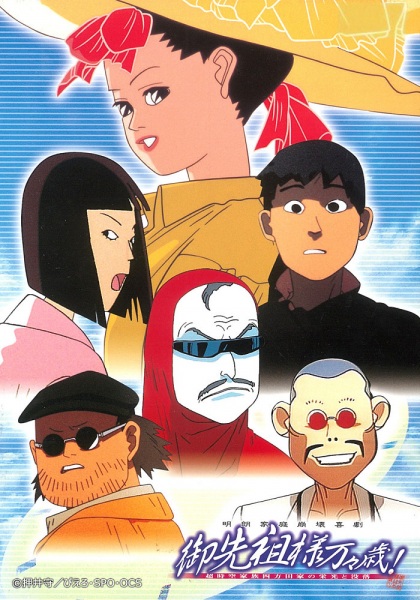
The Yomota family is small and typical: father Kinekuni (42), mother Tamiko (38), and son Inumaru (17). One day, a beautiful girl appears at their front door, calling herself "Maroko Yomota," granddaughter of Inumaru who travels back in time with a time machine to visit her ancestors. Even with Tamiko's strong objection, Kinekuni and Inumaru welcome her to stay with them, and the structure of a happy family has begun to collapse.
(Source: ANN)
Audience reviews
7 · Sample from the first available page, separate from the total number of ratings.
Christiabel
First anime I’ve watched after months. Very good, 8/10. What I liked the most is the exaggerated amount of dialogue and that theatrical atmosphere. Even though only one was truly philosophical and the rest political or social critique, each one has its own value and they’re all very entertaining to listen to.
Regarding the message, it’s an exposition and critique of the American nuclear family inherited by Japan, unfolding in the psychological, philosophical, and political realms. To explain the causes of this phenomenon, it uses politics, narrating the cultural appropriation of American family models by Japan, which the Japanese government exploits to keep the State standing and the danger that its dissolution would entail. To explain the reactions of the members to the phenomenon, it use…
Read at the sourceDISKOWN
Gosenzo-sama Banbanzai! heavily relies on its comedic appeal to engage viewers, featuring limited animation and heavy amounts of dialogue that is more akin to a screenplay than a typical anime. The series executes its animated segments well and features character designs that complement the overall tone. However, viewers who do not find the humor to their liking may not find much else to enjoy. Gosenzo-sama Banbanzai! caters specifically to a particular audience, and those who do not fit that demographic may want to explore other options. Ultimately, the series will likely be well-received by its target audience, but may leave others scratching their heads.
Read at the sourceKamezuki
It's arguably more appropriate to approach "Gosenzo-sama Banbanzai!" as a 6-act animated stage play rather than as a 6-episode anime OVA. All of the characters are positioned like actors (or puppets, even), on a stage, and the way they enter and exit the stage, as well as the lighting effects on them and their long soliloquies, come straight out of the theater.
A tragic comedy in the classical sense, “Gosenzo-sama” is drenched in symbolism, especially with regard to colors and wordplay, and contains copious references to philosophical and literary concepts.
That is not to say that it’s too abstract to be enjoyable, however. “Gosenzo-sama” tells a linear story that’s relatively easy to follow, with the exception of the final episode where the narrative literally and figuratively falls ap…
Read at the sourceOrdinaryguy420
Gosenzo-sama Banbanzai!
This was a very interesting watch. I'd heard people saying it's a "taxing watch" or not suitable for casual viewing but i believe that it's perfect for both casual and critical viewing and that's exactly what was on Mamoru Oshii's mind when he decided on the screenplay. What I mean by it is the fact that the show is presented as a stage drama. Much like Sheakspeare's plays, this show is an artistic commentary on a subject while also being a compelling and enjoyable narrative.
It’s a commentary on the typical japanese family with poor family bonding conveyed through the three characters designed as marionettes fitting a certain archetype.
Almost two third of the first episode is spent showing the seething discontent the three of them have. The entrance of Maroko w…
Read at the sourceKarhu
Gosenzo-sama Banbanzai is an anime I would not recommend to just anyone. It's an obscurity that won't be easy to appreciate. From its directing, it is similar to what Kunihiko Ikuhara first introduced in Revolutionary Girl Utena. From its execution, it reminds FLCL, but also goes into such levels of abstractity, it comes close to animated shorts such as 'Nekojiru Soup' and 'Inaka Isha.' I'd only ever recommend it to experienced viewers and old schoolers.
The anime starts off by a doorbell ringing. Followed by a 10 minutes long debate over who should open the door. When it's finally opened, a person claiming to be a timetraveler is standing behind the door and declares she is the future granddaughter of the house owner's son. This is accepted by the father, and by the son (upon prove), bu…
Read at the sourceUnowen
There is nothing quite like the raw feeling of enjoyment that a viewer can savour throughout their first sitting of a work that manages to mesmerize them.
Nonetheless, when approaching the charms and disillusionments of any show, our vision is rarely able to cope with the bigger picture, and to prove a point we must, more often than not, focus our attention in the specifics. In those details that for some might be of scarce relevance, but that in great measure have the potential to make a difference, both in a good and a bad direction.
There is really no other way to start referring to Gosenzo-sama Banbanzai! than by mentioning its unique conception of staging. In this matter, the setting is eminently static and simple, most of the times simulating an actual theatrical mise-en-scène. T…
Read at the sourceStephen2D
Idiosyncratic and unfairly forgotten, a six-part OVA "Gosenzosama Banbanzai!" (literally, "Long Live the Ancestors!") belongs to the most experimental period in Oshii’s career. Told in the form of a loony play, this farcical tragicomedy revolves around the Yomota family: a teenage boy, Inumaru, his father Kinekuni and his mother Tamiko.
Their normal life starts to collapse after the arrival of a mysterious girl, Maroko, who claims to be Inumaru’s granddaughter from the future. Even though she has a hereditary star-shaped birthmark on her buttock, Tamiko refuses to acknowledge her as Yomota. So, she leaves her husband and son, and hires a private detective, Bannai Tatara, to reveal the true identity of the uninvited guest.
Driven by self-irony and absurd, slapstick humor, a twisted, parad…
Read at the source