Audience reviews
6 · Sample from the first available page, separate from the total number of ratings.
weirdy8
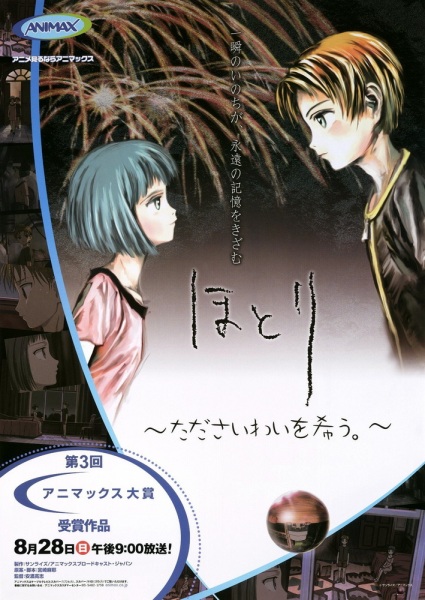
Winner of the 2004 Animax Award for script-writing, Hotori: Simply Wishing for Hope was considered a hidden gem in internet forums back in the day. ANN Founder Justin Sevakis featured it in his Buried Treasure series, describing it as “remarkably grounded and mature in how it approaches a number of sensitive issues.” It has also never had a home release until now, giving it a sense of mystique that obscure anime tend to get. The back cover of this release says it's “The tale of a boy being injected with memories, and a girl who is losing hers.” To put it another way, it's The Fault in Our Stars if Augustus was a robot.
All jokes aside, there's a reason why both these tropes got used: how they value memories. Both live in a world where brain research and AI development has led to early tes…
Read at the sourceFirechick12012
Most of my favorite anime consists of stuff that's either obscure or not very well known, or only well known in certain circles. While I've grown up watching anime, it wasn't until 2005 when I learned that anime was originally made in Japan, and I hadn't quite developed my preferences nor made a point of watching anime all the way through until about 2010, when I was in high school. That being said, I lurk on Anime News Network pretty much on a daily basis, and long ago, there used to be this really good weekly column series called Buried Treasure, where Justin Sevakis would talk about an obscure anime, its history, his opinions on it, and its overall availability. Some were good, others weren't, but I remember always looking forward to those articles as I always found them very interestin…
Read at the sourcemahoganycow
“What exactly makes us people?” is a question that fiction, especially in the last ten years or so, seems to enjoy tackling, and with varying degrees of success. We seem to have an obsession with trying to define the undefined, and figure out exactly what element (if any) dwells within us, differentiates us from each other, and makes us more than just flesh and blood. Hotori: Tada Saiwai wo Koinegau (Eng. “Hotori: The Simple Wish for Joy”) is another one to add to the long list of anime about maintaining an identity in a technologically advanced world, but solid character concepts and good writing in general are enough to make it a standout OVA that floats near the top of the mark.
The story, set thirty years in the future, centers on a place called the “Personality Plant.” At the Plant,…
Read at the sourceggultra2764
This was a surprisingly powerful TV special despite its rather short length. Hotori explores the interactions between a human girl with a terminal illness (Hotori) and an android in the form of a boy (Suzu) who interact with one another as they share the problems they both share with memories, the former whose illness is destroying her memory and the latter whose memories are being formatted to resemble the dead child of a couple looking to adopt him. The special retains a melancholic mood throughout its run in depicting the interactions between the two as they contemplate their individual situations and try coming to some understanding on how to approach them as understanding the human experience is new to android Suzu as he interacts with Hotori, whom puts on a strong front to cover up h…
Read at the sourceplutomutt
Hotori is a movie that picks you up. slaps you in the face, tells you not to cry and then just leaves you there to snivel like a baby, all in the span of about half an hour.
I have to say that I feel bad fo the producers, unless they were going for a minimalistic film this just feels to me like a nice big plot confined to a low budget and bad art. I feel like they wanted to do something but they didn't have the time or money, and thus for me the feeling of a true story I could care about was lost.
It felt very rushed and when the sad moments lasted only seconds I would start to cry only to be carted off to another scene so they could fit them all in the short amount of time they had. I couldn't really care about the characters because I couldn't connect, they seemed very flat and only me…
Read at the sourceArchaeon
Over the decades anime has produced some of the most compelling works of visual fiction on the planet. Since the turn of the millenium though, it seems as though the medium has gradually matured in terms of content and focus. One of the reasons for this "coming of age" is critical and media attention, especially over the internet, however there is an even bigger impetus in this maturation process - recognition as a creator - and it's this driving force that fuels the award known as the Animax Taisho.
Hotori: Tada Saiwai wo Koinegau (or, Hotori: I Only Want Happiness), is the script that won the third Animax Taisho award, and was adapted into an anime in 2005. The original script was written by Miyazaki Maya (I don't know if there's any relation to the esteemed Miyazaki Hayao though), and…
Read at the source