Audience reviews
20 · Sample from the first available page, separate from the total number of ratings.
Squabbitt
I write this review finally, after coming back for a fourth rewatch. I genuinely believe this to be the best and most impactful anime i have ever watched. And the most odd part is, i can't directly relate to any single feeling that was supposed to be displayed in this anime, yet i feel i understand each and every characters decisions.
First of all, the "family" dynamic is so incredibly written finding kinship in someone who is so clearly on the opposite side of the spectrum of feelings than you are, is a beautiful thing when written right - and Ikoku Nikki is indeed written right! It is genuinely a wonderful and completely agonizing time, watching these complete oppositions try and make their lives come together.
I will likely forever hold especially episode 8 to be the single best writte…
Read at the sourceBaconReviews
This anime is absolutely not for everyone. I can easily see how some may consider it boring or pointless, but for those that love subtle character work, and realistic characters do not skip this one.
First off, I'd be remiss to not mention that Kensuke Ushio absolutely kills the soundtrack in this. Every emotion hits harder with his scores, and he does it again here effortlessly.
But the characters, they are so unbelievably flawed. It's a hard balance to strike. There are no grand gestures that reveal their ugly nature, it's all done in the quiet moments and the word choices. Asa is one of the most interesting characters I've had the pleasure of seeing in an anime recently. She may come off as annoying at times, but what high school freshman isn't. The way she deals with conflict and del…
Read at the sourceNelzyr
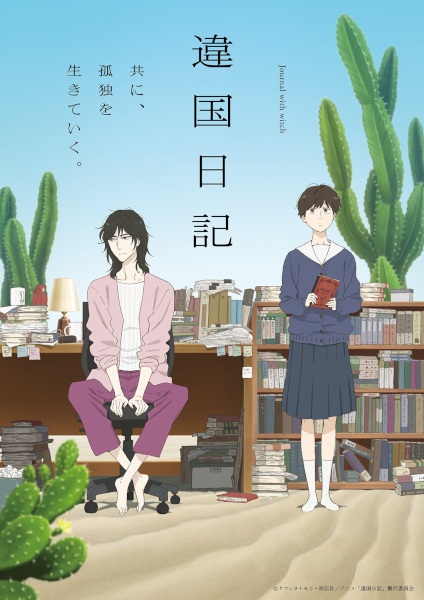
My personal anime of the year going into one of my favorites of all time and probably one of the most overlooked shows of 2026, Journal with Witch
At face value, this anime really doesn’t look like the kind of show that would hit so hard. It's quiet, not so flashy, and doesn’t try to emotionally body slam you every episode at all, *cough*. But somehow it’s the kind of story you slowly grow attached to without even noticing, and I mean REALLY attached to.
A lot of stories want to be loud. Big breakdowns, dramatic confrontations, neat resolutions wrapped up nicely so everyone can cry, clap, and move on. This anime kinda refuses all of that. It lives in the uncomfortable feeling of awkwardness, distance, and emotions that you cannot express fully to other people, and those things are shown…
Read at the sourcecatscorner
The basic premise of Ikoku Nikki is interesting, and the themes being explored are universal and done realistically. However, there are many problems with its execution: its constant time-shifting scenes make it confusing; it tries to pack too many hinting details that water down its comprehensibility; there is a general lack of logical progression in the story, and the artwork and music are plain comparing to the standard of the time.
Even in the slice-of-life genre one can objectively argue that it's flawed. Natsume Yuujinchou, which is made by the same studio Shuka, is of similar kind where daily experiences are conveyed and explored, but each episode tends to have a unifying theme and the progression of the story is highly coherent. Ikoku Nikki, by contrast, receives a lot of hypes fo…
Read at the sourceTinnFoil
Ikoku Nikki feels pretty deep. It feels as though it has many things to say about grief, relationships, and emotions. Does it actually? Your mileage may vary.
This is a pretty art-sy anime, and it does a lot of things right. It has, in my opinion, profound things to say about the human condition. The characters are weird and extreme, but also distinct and enjoyable. The animation is relaxing and satisfying.
Ikoku Nikki struggles most in its storytelling. I found myself enjoying each episode, and the messages each conveys resonated deeply. However, I find that the anime as a whole is less than the sum of its parts. I felt that, by the time I had reached the end, there were so many questions that had no answers. So many side-plots were started, and so many of them never got a clear, satis…
Read at the sourceDarkfiend47
My Original Review on Medium: https://medium.com/@maguscodex/journal-with-witch-a-realistic-depiction-of-grief-loneliness-690b4947b904
Ladies and gentlemen, this is why I love anime. Every year, some shows go under the radar just because they’re different. However, they turn out to hit me harder than the popular ones and I try not to miss out on them. We’ve had shows like Pluto, Orb and Odd Taxi in recent years, and now, we have this.
I was just thinking about the sheer duality of anime. I recently finished the latest season of Jujutsu Kaisen, which is full of flashy fights and pure spectacle, but this is the complete opposite. Despite the title, there aren’t any witches. There’re no superpowers or hype moments. It’s realistic and grounded. It deals with real life issues like the loss of…
Read at the sourceTomasAlgerio
The first episodes of "Ikoku Nikki" (2026) are bittersweet. There’s a sense of estrangement and distance between the two protagonists, brought on by the loss of someone who was (for better or worse) key in their lives.
It feels like every conversation carries a heavy emotional weight, as they are constantly interrupted by sudden memories that take time to process. Not many anime portray the grieving process in such a restrained way.
Also, its handling of time is excellent, because when you least expect it… a seemingly isolated line of dialogue can come back in a powerful way to reinforce its meaning.
It’s a shame I can’t say the same about the second half of the series, since the addition of so many bland characters (like Asa’s school classmates) makes it lose some of its strength. But…
Read at the sourceMaddtiltanime
This is quite possibly the best mature anime that explores the theme of grief. You are missing out if you are not watching this gem.
The characters are well written and memorable. The characters in the series are very realistic and the anime does a good job portraying them as if they were everyday people. They're also interesting to watch. They have their own unique personalities and quirks and their interactions with each other is quite a spectacle.
This anime feels like you're reading a novel. It has many creative symbolism and metaphors like normal novels but it also has the dramatic slow burn that appeals to mature audiences. It's philosophical but emotional and it does a good job creating a sensitive story that also connects with viewers. Many people go through grief and as a resu…
Read at the sourceChuy_diazz
More than a review, I'm here to offer a reflection:
"Think, think, and then stop thinking."
Life is fleeting; everything passes in the blink of an eye. We strive to do things the right way. Simply put, we try to fulfill the cycle that nature assigned us: birth, growth, reproduction, and death. Consciously, we try to add more layers to that cycle: going to school, having a career, getting married, having children so we can say we're someone in life. We all follow the same path, one after the other. We're promised that this is the path that will lead us to happiness. Then, we start to think, "Is this the only right way to live?" Not everyone wants to study, not everyone wants a career, not everyone wants marriage, not everyone wants children. Not everyone wants to live... at least not that…
Read at the sourceelumizu
Stories about grief often promise catharsis. They move toward reconciliation, emotional breakdowns, or some decisive moment that restores order to a broken life. Ikoku Nikki chooses its own unusual rhythm. Instead of dramatizing loss, it meanders in the strange and disorienting aftermath of it, the uncertain days when nothing feels resolved and two people who barely know each other must learn how to coexist in the shadow of something that cannot be undone. The story begins with Asa Takumi, a teenager who suddenly loses her parents and ends up living with her reclusive aunt, Makio Kōdai. At a distance, the premise resembles the familiar outline of a “found family” narrative, and yet the series soon reveals that it has little interest in easy emotional comfort. Makio is not the warm and nurt…
Read at the sourceimquotable
Ikoku Nikki is an anime that’ll get robbed and won’t even make it into the AOTY nominations.
What’s notable is what the show doesn’t do. It doesn’t milk grief. The parents’ death exists, but it’s not weaponized. The loss is just there. It sits in the background and leaks into everything without being pushed in your face. In most shows, this kind of setup gets used immediately to pull emotion out of the audience. Ikoku Nikki does the opposite. It makes you want Asa to cry. She almost doesn’t for two full episodes, holding everything in, staying quiet. And because of that, it hits much harder when she finally breaks down.
Personally, what I loved most is how the show keeps slipping into visual metaphor, cutting away from literal space into emotional space. A conversation in the apartment…
Read at the sourceExplodingBrain
Short review - Ikoku Nikki: niche but in depth into personal & society issues, overall it is a great anime, will recommend if you want to watch non-mainstream animes and ponder on such issues
Story: 9/10
Character design: 9/10
Animation: 7/10
Music: 8/10
Enjoyment: 8/10
Overall: 8.5
----- Longer review (Pros and Cons) ----- S- First half focus more on personal issues, such as love and grief, how to deal with trauma, understanding each other, while later half focus more on society issues, such as discrimination, stereotypes and identity crisis. The story goes deep into these issues, showing the pain and growth of the characters in a honest, touching way.
The core of the show is about accepting yourself and be free from trauma.
The trauma you have experienced will reflect in the way you…
Read at the sourceAeolonox
Nowadays I'm not a person who has it in me to write at length, much less something as comprehensive as a full-blown review. Although there are a number of critics whose thought pieces I have great respect for, I've never had their dedication to continuously deepen my knowledge of artistic mediums or develop the eloquence needed to convey my thoughts on creative works in a sufficiently compelling manner. But for all of Ikoku Nikki's fantastic qualities, it's the series' motifs around both journaling and wandering through foreign lands that resonated with me the most and gave me the impulse to try writing my thoughts on it, as my way of stepping into an unknown area outside my present-day comfort zone and getting my own thoughts about the series into text. That might be the best endorsement…
Read at the sourceriz_76
Been a long time since I found an anime I really liked. This is marked as josei, but I would say the sub-genres are more slice-of-life and drama, with only a very small touch of romance. The series deals with topics like adulthood, teenage life, grief, loss, gender, and relationships.
The graphics or art feel a bit wooden at times and suffer from the typical repetition and sameness seen in many Japanese anime. The soundtrack and background music, however, are well chosen and fit the storytelling quite well. The dialogues are mostly good, but the use of pauses and silence does not always work. These moments seem intended to build depth, hint at complex backstories, or convey unspoken thoughts, but they do not always land effectively.
Still, the topics it explores are not commonly found in…
Read at the sourceLetterBeez
A leaf floats down the river swirling in eddies and drifting in currents but even in it's quiet beauty it finds it's way to the end you knew was coming all along.
I haven't read the manga so I can't say how well the anime adaptation stacks up but as an anime it's extremely good. The story won't resonate with everyone but for those who have gone through traumatic loss or those who live in a world not made to fit them it's a story that leaves you both satisfied and wanting more.
The animation is good but it's nothing amazing, the voice acting on the other hand is excellent and goes a long way to draw you into the character's lives and let the story shine. The story isn't anything particularly new or exciting in itself but it's handled and crafted with excruciating care making sure that ea…
Read at the sourceCaptainKenshiro
This is a slice of life series that seemingly combines a somewhat atypical premise with a theme or topic that I’m fond of, so it became instantly interesting for me to check out. The second one is childcare, as in, an adult character seeing their life changing because they start to take care of a child, in the likes of Aishiteruze Baby, Usagi Drop, Kotaro Lives Alone or something like that, or so I assumed, but since the kid in this series is a teenager and not a child, that dynamic is different than the one from those shows.
And although some aspects of the everyday life of Makio, the adult of the story, do change, you don’t feel like living with another person really changed her life all that much, which to be fair it was also the case in all the aforementioned series. I mean she and so…
Read at the sourceFlowMAL
Ikoku Nikki is one of those shows where I just know a lot of people won’t even give it a chance. You look at the genre and the Josei demographic, and it doesn’t sound “exciting.” And yea, I understand why. It’s not something you can casually put on in any mood; it requires emotional engagement. But if you give it that chance, it stays with you in a way few shows do. It feels less like an “anime” in the traditional sense and more like a grounded human drama.
What makes this show so captivating is its thematic depth. It begins with grief and loss, but quickly expands into questions about identity, individuality, and societal expectations, constantly asking whether standing out is something to embrace or avoid. It also explores something even more uncomfortable: the idea that not everything…
Read at the sourceMarinate1016
“What you feel is up to you, and no one has the right to blame you”
I’m not being hyperbolic when I say Ikoku Nikki is one of the best and most realistic depictions of depression, grief and adolescence in anime history as well as one of the best anime I’ve ever seen. It is the quintessential coming of age story and every single episode is crafted with the utmost care and reverence for the subject matter. I really struggle to put into words how beautiful this show, I wanted to start this off with some fancy wordplay and complex jargon, but I’d rather speak from the heart and tell you why this is so special to me. As someone who lost my father to cancer at 15, I saw a lot of myself in Asa’s story. While I can’t say I was as cool as she is, I found myself angry at the world and acting out f…
Read at the sourceZNoteTaku
It would be easy to point to something like Kübler-Ross’s “The Five Stages of Grief” as being the script through which we experience shocking loss. The problem is that doing so presumes that we as people operate in such a methodical manner. We don’t. Especially since not all losses are created equal, and everyone is just as different as everyone else, there’s a certain extent to which those who grieve (even in the world of fiction) need to be given a degree of latitude. It’s particularly true when loss happens to one’s own family, regardless of whether there were close ties or not. Throw in it being your parents, that it happened in a flash, and that you haven’t even entered high school proper yet, and it’s not simply that “they’re dead.” There’s nothing simple about that. Your life has be…
Read at the sourceMcsuper
The power of human understanding is profound, but how much do humans truly understand other people? We can try to shed light on someone else’s heart through communication, but what happens when that light is too bright for someone else? They will look away. Ikoku Nikki is about a lot of things: grief, loneliness, communication, and finding solace and healing.
Ikoku Nikki takes the delicate subject of grief and tells us that emotions are not linear, but rather, something that does not arrive as one wills it to. Elisabeth Kübler-Ross, in her 1969 book, On Death and Dying, introduced the “five stages of grief” model, which includes denial, anger, bargaining, depression, and acceptance. While this model is widely used to describe human emotions, reality suggests that everyone follows a differ…
Read at the source