Introduction
One does not need dance to live.
In 1374, during the turbulent age when the Northern and Southern Courts were locked in conflict, the Northern Court's shogun, Ashikaga Yoshimitsu, was becoming an increasingly dominant force.
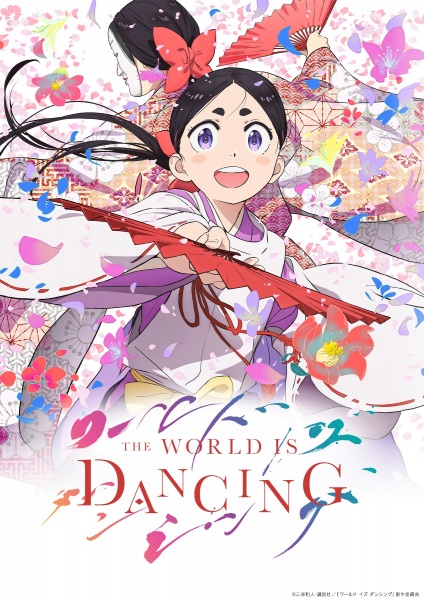
Born the son of Kanami, head of the Kanze troupe of sarugaku performers, Oniyasha drifts through his days with a hazy question lodged in his heart: Why do people dance? His spirit remains clouded, until the day he encounters a dance that is truly "good."
Curious, sensitive, and strikingly beautiful, the boy meets people, laughs, cries, confronts his own weaknesses, and slowly begins to shape a new form of dance for a world steeped in impermanence.
(Source: Shochiku)
Audience reviews
7 · Sample from the first available page, separate from the total number of ratings.
marioink508
Completed - 7.90
THERE’S MORE TO THE WORLD THAN JUST VICTORY OR DEFEAT
The World Is Dancing is an absorbing dramatic lens into the history of traditional Japanese performing arts—a character-driven series dealing with coming-of-age uncertainties, overflowing creativity, and the growth of theatrics, tracing it back to where it all began. Throughout the experience, The World Is Dancing follows several stories, all of which are anchored in the world of art, most notably in how creativity manifests itself within the human body—how something as simple as boredom, or as heavy as tragedy, can ignite the most ambitious ideas. The prologue contains arguably the single most thought-provoking themes the series ever attempts, exploring self-expression under confinement, and the catharsis of feeling…
Read at the sourceHenelyThornhill
Man, I’m gonna miss Onyasha so much.
This anime accomplished something truly rare these days especially : it made me feel attached, involved, and genuinely invested in watching a character evolve over years. Seeing that final performance from Oniyasha and the whole troupe made me profoundly emotional. I didn’t cry, but it hit something deep.
And what I love most is that it’s not really the end. The whole idea of art evolving is that if you truly want it to survive, you have to challenge it. Change it, adapt it, mix it with something new, cut away what isn’t necessary, and preserve what matters most. What Oniyasha and the troupe accomplished at the end felt like a beginning.
Honestly, I don’t even want a second season. It just feels right to leave them here and let history tell us what c…
Read at the sourceRushingSugar
The show is beautiful, high quality and has a really strong start, but it's incredibly rushed. There's many moments where details would've mattered a lot, but things kept being sped forward and skipped. Some of the tragedies and inner turmoil of the characters did not stick because there was never any buildup of meaningful details. It's a shame because the show is very high quality, but I guess they were mostly trying to advertise the manga.
I really dislike the shogun's character. He effectively replaced the father as the main authority figure early in the story, but he is such a terrible replacement. The father was all about dancing, which I assumed a story called "The World is Dancing" should be about. BUT NOPE. We throw away the father and replace him with some weirdo shogun whose ch…
Read at the sourcemetaldestiny
I regret finishing this. Every episode, I thought to myself, "okay, I gave it the three episode rule, maybe just one more, maybe the next one will be better" but it never was. It had just enough interesting moments (mostly the shogun and the background conflicts) to keep me thinking it might elevate itself, but that never came. Oniyasha is extremely grating, irritating, unwatchably tiresome. The show would be far better without him: which is a problem, since it's about him as the main character. The show takes few risks, and just walks away from conflict (like the poor woman who was forgotten after a few episodes, and the same for most of the other unfortunate cast who were affected by the political and economic climate). Oniyasha is a spoiled, privileged brat. The lack of risk taken in th…
Read at the sourceJonaRM
This is the story of Oniyasha, the heir to a troupe dedicated to performing an art form known as *sarugaku*. Initially, he doesn't understand why he must learn this dance, but he eventually discovers the answer; along the way, he faces various challenges that help his art evolve and give birth to something entirely new.
We first meet Oniyasha as a child, and the episodes chronicle his growth; he develops a perspective that differs from those around him, making him something of an artistic revolutionary.
The story is based on real events—though I’m not sure how historically accurate it is, given its roots in ancient Japan, it seems quite faithful regarding the artistic aspects. I loved how they handled the dance sequences; I imagine that was the biggest challenge.
The animation is excell…
Read at the sourceSkyBlue1012
MODERNIZATION OF TRADITIONAL DANCE
I'm not familiar with the traditional dances and performing arts of Japan, so I can't really comment on how historically accurate the series is. However, I appreciate that it takes the time to explain the story and context behind the dance performances we're about to see.
No one in their right mind would dare complain about the animation quality. Animating a character while they're dancing is incredibly difficult, yet the series manages to give us fully animated performances instead of relying on slideshows, still images, or montages.
The characters are also complex. They each have their own individuality and motivations instead of simply existing to move the plot forward. My favorite character in the series is Kogane. His tragic life has a profound…
Read at the sourceabystoma2
Now this is an anime that take you in right from the first episode. Dazzling sakuga pump up the dramatic scenes with juice and the dance choreography, utmost the one from first episode’s finale, bares its humanity.
The young protagonist, from a privileged background of son of theatre company’s head and the successor, is shocked in clash with reality of the destitute. Shock which kicks off the chain reaction of the story. Shock, which inspires to ask “What is good?” – being asked both by the character and by the audience. The dance that he sees is so intimate and personal, born of thick emotion and desperation, so different from the more formal performance theory Oniyasha, our protagonist, is familiar with. And it is this question of what is good that serves as one of the main thesis of W…
Read at the source