Audience reviews
20 · Sample from the first available page, separate from the total number of ratings.
Lilylouiseo22
absolute beautiful art that people all should watch before they die.
im not even exagerating if art and music was word sumerized it would just straight up be inu-ou i loved everything about this work of art, from the story, the characters, chemistry, the animation, music and the bittersweet ending. i think this anime deserves more recognition than it has right now, for the fact that its not even on the top 100 is a scam.
everyone who has a pulse. watch this. u dont even need too have eyes to see the beauty of inu ou you straight up can just even HEAR THE MAJESTIC SINGING OF AVA CHAN. and the beautiful singing of everyone. the strums of the shimasen is crazy ( was it biwa? ) the fact that the settings is in ancient japan but the music that tomoari played was metal(?) is a crazy ass pull…
Read at the sourceCluelessWorm
(Not a proper review, just some thoughts copied and pasted from my Letterboxd)
At first, Inu-oh felt extremely different from anything Yuasa had made (of course, the art style and his unique way of animating how his characters move were still there), but I was on board from the very first frame. And then, about thirty minutes in, Tomona performed the first song, and everything seemed to fall into place. There was the Yuasa I know. And, in typical Yuasa fashion, the last few minutes ripped my heart out of my chest, and I bawled my eyes out as the credits rolled. At this point, I think I will fall in love with anything Yuasa makes. It’s sad to see his Science SARU era end, but I’m excited to see what comes next.
Inu-oh and Tomona are like two pieces of a puzzle that fit together perfectly,…
Read at the sourceabystoma2
Yuasa once again proves his inability to make bad movies. This time, he tested his directorial craft with a musical, and yep, still worked out great. Now of course, this isn’t just your regular musical. No, here you are offered unique combination of traditional music presented with rock aesthetic, ahistorical historical story and all that delivered through quality animation.
The atmosphere is top notch – those fictional performances on your screen really makes you feel like you are actually at a live concert. The music has its own unique style, one that holds tribute to classic rock but does so in an original way. It’s the type of soundtrack that you can listen to even separately. The tracks of course aren’t there just because, in tandem they tell the story of protagonists and the story t…
Read at the sourcesir_biggy
Hmmmmmmmmmmmm... what to say, what to sayyyy, this show's good but that alone wouldn't be doing it justice now would it? So then, let's get right into it
Let's start with the animation, my favorite thing about this entire anime. The character designs were so unique each and every second was a pleasure to watch, how do I put this, everything seems so alive( I mean I know they're alive duhh,but..but.. yall get it) I even liked the rotoscope( not sure if it was) in some parts of the anime. Long story short,the anime is a solid 10
Moving on, the story,albeit very similar if not a clone or inspiration maybe of dororo minus all the violence, is pretty solid. Instead of killing demons to get his body back, he dances,yep he sings and dance, that inu-oh be putting Micheal Jackson to shame with th…
Read at the sourceBensonas
What a lovely suprise this was. To be clear upfront, this is not your typical anime film. Despite that, it's really rather brilliant.
Let's start at the animation. It is excellent. I'll clear this up straight away, it's a 10/10. One particular scene that stood out was before the final performance of the film, there is a moment when the camera is moving around the complex where all the people are talking about Inu-oh and it's incredible. It's not your standard anime style either which is incredibly refreshing. It gets everything right. Every single frame is perfect and exactly what it should be. The performance scenes also deserve a specific mention. There are incredibly captivating and quite moving at times. The animation alone is enough to keep you engaged through the film, it's that go…
Read at the sourceHalcyon13
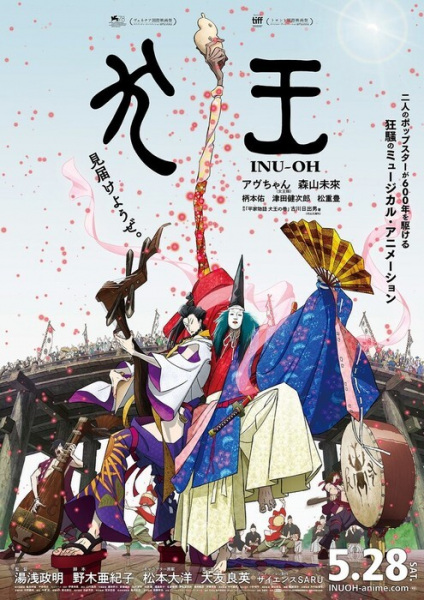
A culmination of song and dance can be enchanting, even more so in a film, presenting both in musical form. Musicals, when crafted with heart, complement the cinematic fantasia well. Masaaki Yuasa's Inu-ou captures the fresh spirit of historical interpretation, and while there is some sacrifice, it is granularly joyous. The marriage between Japanese Noh and rock opera reinvents the presentation of musical theatre in animation, visually justifying the grand scale of each and every successive performance. Inu-ou follows the titular Inu-oh, a high-spirited, deformed boy born with a curse, and Tomona, a blind biwa musician. Both have a chance encounter one night and find harmony in Inu-oh creatively dancing to Tomona's music. To successfully break the curse, the two band together, showcasing t…
Read at the sourceboguda
Masaki Yuasa's love letter to music, storytelling, and all things creative.
Two young kids cursed by fate come together to craft banger hair metal songs in ancient Japan. It's an absurd premise, but absurdity is Yuasa's bread and butter.
The melodies and traditional Noh dances not only transport the viewers to feudal Japan but also illuminate the lives of the Heike soldiers, a mixture of history and myth that is intertwined with our main characters' story. The breathtaking visuals and meticulous storyboarding held me captive from start to finish. I honestly can't recommend it enough, it's a sensory trip.
Even if you skip the anime, give the OST a listen.
Read at the sourceThebruhhomie
-Inu-Ou Review.-
Most modern anime movies (that aren’t tied to a series that is) usually fall into one of these two trends: Makoto Shinkai rip-off or Ghibli rip-off.
But there was a time, years ago, when this wasn’t the case.
You won’t believe this, but there was a time when weird movies like “Memories”, Satoshi Kon films, and Mamoru Oshii movies got made and released. If they were successful or not at the box office, it does not matter, because the thing is that they actually got made and became classics that will be revisited for years to come.
But because anime nowadays is as popular as it ever has been, “weird” films are just not going to get made because if you are gonna appeal to the widest audience possible you have to play it safe. So make a movie that’s a sequel to an alread…
Read at the source-AlexL-
Inu-oh is an unique cinematic work that delves deep into the journey of discovery and self-acceptance, challenging the definition that society tries to impose on who we are. The film explores the difference and beauty of individuality in an artistic and reflective manner, touching on themes of exclusion, acceptance, and the struggle against the world's tendency to reject what is different.
This audio-visual spectacle delves into the critical point of individual identity, challenging the social definition of personality. The film also addresses themes of historical complaint, rejection of the new, and issues of authority, politics, and ownership in the artistic sphere.
Inu-oh stands out for its emotional animation and immersive soundtrack, with lengthy musical segments that, although chal…
Read at the sourceChiaki_Shura
With this film, Yuasa offers us a work that encapsulates the history of the conflict between the Taira and the Minamoto (although in the film, this conflict is already in the past) and reimagines the story of this conflict primarily through the language of music.
The very work from which the film is partly derived, the "Heike Monogatari" (a Japanese literary work that, in theory, should be historical, though we cannot confirm everything written within it), initially saw its spread through the tales of the Biwa Hoshi, itinerant minstrels who contributed to the dissemination of various versions of the "Heike Monogatari." The presence of these Biwa Hoshi is predominant in the work. One of the protagonists, Tomona, is indeed a Biwa Hoshi.
The plot revolves around Tomona and the mysterious In…
Read at the sourcewhiteflame55
An excellent movie with direct ties to The Heike Story (an anime from 2 years ago that I liked quite a bit), I found this one a less impactful on an emotional level, though what it doesn't have there, it makes up for with incredible visuals and powerful music. I can't recall seeing a movie so artfully present the "sight" of the blind, and the storytelling in this movie is truly master class as each song comes with a dazzling set of visuals. That being said, the modern story feels a bit underdone, there was a plot element that felt like a weak and underwhelming version of Dororo, and the way things wrap up didn't quite work for me, though the ride was well worth it.
Read at the sourceTheRealRouges
First thing and the most important: this movie is insane, I was in awe throught the entire 90 ish minutes it lasted.
I'm gonna start my review by saying I'm not particularly a fan of Masaaki Yuasa, apart from Tatami Galaxy, Ping Pong and Kaiba I didn't really like his other works that much (especially that awful Japan Sinks 2020, that was just pure garbage), but this movie is really a damn masterpiece.
For context, to enjoy it the most you should be kinda familiar with some aspects of Japanese history, namely the Genpei war (for that I can recommend the brilliant Heike monogatari anime series, made by the same studio of this movie) and the Nanbokucho period of the Ashikaga shongunate, the era in which this movie is set, and a bit of Noh theater's history, since we see the two most importa…
Read at the sourceggultra2764
Inu-Ou has quite a bit it dabbles into regarding creative freedom within feudal Japan in its focus on a blind biwa player named Tomona and a disfigured social outcast named Inu-Ou, the son within a family of Noh dancers, who form their own dance troupe to portray their own version of stories related to the Heike clan. However, their fame and unconventional storytelling clashes with the traditions enforced by the Japanese shogunate, leading their paths to inevitably entwine.
Before I get too deep into my thoughts on this film, some quick historical details on what Inu-Ou is portraying. During Japan’s feudal era, creative freedom with outlets like musical and theatrical performances were strictly regulated by the shogunate to suit the tastes of whomever was in power and craft a desired unif…
Read at the sourcemoonbell
Cobbled from my two Letterboxd reviews of the same:
I'm not a very good film reviewer. I really want to explain how I feel about Inu-Oh, but I'm not quite sure I have the words. Still, after catching the only screening of it in my town, I waited for the home video release then forced 15 people to sit down and watch it so I feel like I need to somehow articulate at least part of what I feel:
First things first, I'm a devotee of Yuasa's, so I might be biased. It's hard not to be. He has yet to let me down in any way, and while he says this project fell into his lap by chance, I literally cannot imagine anyone else doing it justice the way he has.
As an artist, Inu-Oh means so much to me personally. The first time I watched it I wept in the cinema several times. At first I cried because of…
Read at the sourcekarumina_danza
At this moment I have seen four works by Yuuasa and came to like him a lot for his vision. Every one of his films brings in something new to the mix and this has been the case here as well.
This is a story on healing power of art and stories. The music and lyrics serve as exorcism and hold a strong appeal. A multi-faceted story on freedom of expression and what happens when you suppress it. As with other Yuuasa's works, you will find a lot of psychological undertones which sometimes take serious and graphic form, but it adds to the power of this film indefinitely.
Even though the songs feel stretched out, I still love this film for its message and symbolism. Let yourself be inspired :)
Read at the sourcePiggytripper
Going in I had no idea this would be connected to Heike Monogatari (dir. Naoko Yamada which everyone should watch!!) in any way but it was a pleasant surprise. Not only were both of them created by the same studio and released very close to each other, both are about the power of story telling and use the Tales of Heike as a backdrop. Its obvious this is meant to be a companion piece to the anime (or the other way round idk). But its the contrast in how these two approach these themes of storytelling that makes it so fascinating to me. While Heike Monogatari was focused more on the healing power of storytelling, Inu-Oh concerns itself with the themes of freedom of artistic expression. Heike Monogatari also felt subtle and precise, especially with its animation style and Inu-Oh is unrestrai…
Read at the sourceS0UVIK
I never write reviews but Inu-oh was so good, it compelled me to just type down some of my immediate thoughts.
I waited years to watch this movie, and I can finally say that the wait was worth it. I would go as far as to say that this is Yuasa's most expressive work, even more than Mind Game. Yuasa mentioned that he might be taking a break from anime if I recall correctly, and even if (God forbid) he never comes back, this is a fitting end to his career.
Like another user mentioned in the forums, this feels like the spiritual successor to Yamada's Heike Monogatari, especially because that was also made at Science SARU. Both works are extremely different takes on the era covering completely different things, but both of them flows in the same vein.
Yuasa's Inu-oh is feels more of a perso…
Read at the sourceChrismas95
I went into Inu-Ou completely blind. The synopsis on MyAnimeList didn’t grab me, but since friends were watching it I decided to have a gander. And I’ll admit: for the first stretch of the film I had no idea what was going on and if the movie had substance. Even at the end I wasn’t too sure how certain aspects of it played into the story. But even then, Inu-Ou was such a magical and unique experience that I came out of it completely wowed.
Inu-Ou is weird, but in a good way. It takes place thousands of years ago and everything about the film’s presentation does an amazing job of seeping you into that world — from the art style to the environments to the characters to the narration. (Even how it portrays things like blindness is creative.) You start off with biwa on its own and feel right…
Read at the sourceboykunron
Inu-Oh is Yuasa’s magnum opus. By far his most ambitious, spectacular work to date. Watching this movie on a monitor or laptop does not do justice to the musical performances in this film. It’s a cinematic experience and by the end of it you’re begging to hear and watch more. Yuasa has created something very special here, like most of his projects, Inu-Oh challenges conventional anime story telling techniques and practices. The narrative of this film is a bit hard to follow upon first watch and requires some supplementary research about the Heike Story and time period, but the plot is entirely fictional.
Inu-Oh is essentially an anime rock opera influenced by the likes of Queen and King Crimson with sakuga galore. The music is nothing short of anthemic and will appease to everyone watchi…
Read at the sourceTurtles_cute
Bear with me, for this is my first review on this website, but more importantly, this is the first anime for which I feel the need to write one.
Inu-Ou is a musical in the truest sense of the word, in that it presents almost all of its story beats through the art of music. A fantastic musical at that, as the use of the biwa in the film alongside some other instruments as well as their melding with modern music left me in awe, as I am a person who is not particularly interested in music. The music is magisterial, commanding the progression of the story every time it swells and falls.
Speaking of stories, Inu-Ou tells three in its runtime of an hour and a half and some odd minutes. It is hard to follow, and the film moves at breakneck speed without any regard for the viewer's convenience,…
Read at the source