AniWorthNightsong of Splendor
Introduction
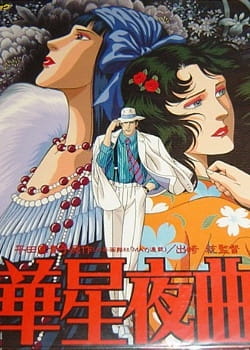
The story takes place in old Tokyo, the Tokyo of August-September 1923 (Taishou 12). At this moment in time, the city is a mixture of extremes...past and present, rich and poor, good and bad. This is a city where we see both horsecarts and motorcars, swords and pistols, lords and businessmen.
A wealthy woman from an upper-class family finds herself attracted to a handsome young man, Taka. He and his younger brother seem to be allied, perhaps not entirely willingly, with some of the city's criminal underground (Yakuza). The lady's lovely young maidservant, Sara, meets him too, and a conflict ensues which can only lead to tragedy, passion, and dishonor. But, as events move on, and the days pass, the viewer sees a terrible date coming closer... that unforgettable day of September 1, 1923, at 11:58, when the Great Kanto Earthquake and tidal wave struck Tokyo, causing the death of almost 100,000 people, one of the greatest disasters in human history.
(Source: The Technogirls)
Audience ratings
MyAnimeList / Tenrai : 6.81/10 · 1282
| 1/10 | 24 |
|---|
| 2/10 | 11 |
|---|
| 3/10 | 26 |
|---|
| 4/10 | 45 |
|---|
| 5/10 | 115 |
|---|
| 6/10 | 271 |
|---|
| 7/10 | 344 |
|---|
| 8/10 | 228 |
|---|
| 9/10 | 113 |
|---|
| 10/10 | 105 |
|---|
Audience reviews
5 · Sample from the first available page, separate from the total number of ratings.
daniqm
I'm unsure about how I feel about this anime. The story started off well, and I found its unique approach interesting. However, halfway through the second chapter, it seemed to lose its meaning in terms of how the relationships in the story were developed. I understand it's a short anime, but it lacked context and proper character development. Everything related to the characters was quite confusing. The ending is left open to interpretation, which wasn't necessarily bad, but it wasn't outstanding either.
One thing worth mentioning is the outstanding animation and character designs. They have a very aesthetic appeal, and I appreciate the dramatic shots reminiscent of a Mexican soap opera. I would recommend it if you're interested in watching a perplexing love story.
Read at the sourceKamezuki
With aesthetically pleasing character designs, a Taisho era setting, and intriguing tales of romance against the backdrop of a natural disaster, “Kasei Yakyoku” is a decent OVA. However, with only four episodes, it is far too short to provide necessary character development and a satisfying resolution to the story.
The character-driven plot involves a rich young woman named Akiko; her maid, Sara; Kiyosumi, the wealthy banker that Akiko is being pushed to marry; and Taka, a handsome member of a crime syndicate. All of the characters, rich or poor, are restricted in some way. They yearn for freedom and independence, and think that the others have what they lack, although those that they consider “free” are just as bound as they are. As the drama centered on these characters unfolds, and the…
Read at the sourceazizsahar
This had so much potential, but was poorly executed on different levels. Makes me wonder and eager to search more for the ideal work by Dezaki. I'm really interested and fan of two things in this: the historical period it is dealing with, and realistic anime, both in the art and storytelling. I just love these works where they try to make characters and situations look and act as real as possible, competing with films even. Curiously, plenty of such examples (and far better) are found in manga compared to anime. Imagine if this was done by a talented group specialized in noir, my rating would definitely go higher than 6.
Read at the sourcesorcery
How much are you willing to sacrifice in the name of love? KASEI YAKYOKU is asking this simple question, answering it through the hazards of four characters during a tumultuous era of the History of Japan. KASEI YAKYOKU is an original Josei tale that revolves around the idea of emancipation. Sure enough, the personal dilemmas of Taka, Akiko, Sara, and Kiyokuni all hinge on it. Akiko wants to escape the confines of her father's prestigious house, the Marquis Hasho. Inspired by the ideals of the first wave of feminism, which were popular at the time, she views the traditional Omiai system as an outdated matchmaking device, much to the dismay of Kiyokuni. Her assertive femme du monde composure shatters after she first interacts with the man she falls for, revealing the harrowing reality benea…
Read at the sourceInes_Osman
It's a beautiful love story, although it's a bit short and has an open end.
It shows faithfulness and pure love despite hard circumstances and poverty, and that love can't be bought or forced ...
It also shows the sadness of both poor and rich people (how poor people have to work hard to live and not choose the easy way to earn money by throwing away their dignity and selling their bodies, and how rich people have difficulties to live free of the family obligations and formalities and to trust people...)
The end was clever, it wanted to show that people can begin from zero and change themselves to be better and change (for the sake of the loved one), exactly like did Japan after the disastrous earthquake...
The development of the characters was good (compared to the number of episodes).…
Read at the source