AniWorthAnju to Zushioumaru
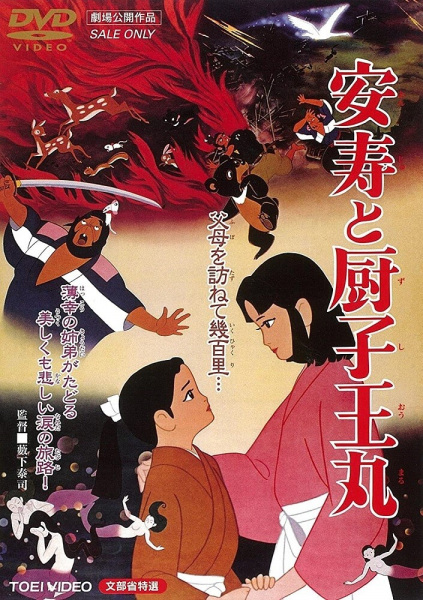
Introduction
Anju and Zushioumaru live a peaceful life in rural Japan with their kind and gentle father—the steward of the emperor's hunting grounds who teaches his children to respect nature and protect animals. The local lord frames him for burning the hunting grounds; Anju and Zushioumaru, along with their mother and a few animals, escape to Kyoto to ask the emperor to pardon their father.
However, Anju and Zushioumaru are separated from their mother and sold into slavery after being tricked into boarding the wrong boat. Their cruel master forces them to perform extreme acts of hard labor under the threat of torture. Fortunately, Saburou—their master's son—is sympathetic to their plight. The siblings wield no weapons and constantly fear the punishment for unobedient slaves. Under these unfortunate circumstances, they must desperately work to regain the happiness they once had.
[Written by MAL Rewrite]
Audience ratings
MyAnimeList / Tenrai : 6.22/10 · 1245
| 1/10 | 27 |
|---|
| 2/10 | 21 |
|---|
| 3/10 | 39 |
|---|
| 4/10 | 100 |
|---|
| 5/10 | 202 |
|---|
| 6/10 | 308 |
|---|
| 7/10 | 255 |
|---|
| 8/10 | 155 |
|---|
| 9/10 | 80 |
|---|
| 10/10 | 58 |
|---|
Audience reviews
4 · Sample from the first available page, separate from the total number of ratings.
Xristophoros
While The Littlest Warrior is not a remarkable film, it is certainly a competent work, especially considering the era it was created. This is a family-friendly retelling of the original live action classic "Sansho the Bailiff" (1954). Compared to the former, The Littlest Warrior comes across as diseny-esque in more ways than one. There is an emphasis on animals providing comic relief in several instances as well as a focal point for children in order to hold their attention throughout. While not a bad thing, it did feel a little bit forced and gave the impression that the film had an identity crisis. At the time of its production, the anime industry was still finding its footing and took great inspiration from Disney productions and this film is clear indication of that. Distrations aside,…
Read at the sourceGsarthotegga
I know hardly anything about the production of Anju to Zushioumaru, except that it's based on the same folk tale as Mori Ogai's short story, Sansho the Steward, as it's known in English, or Sansho the Bailiff, as the more famous Kenji Mizoguchi film is titled. Compared to Mizoguchi's adult film, this animated adaptation has a Disney-esque feel, as was typical for these older, more lavishly animated films. You know what that means: constant cute animals taking attention away from the story (just like those blasted April Fools' Day cat paws treading all over my screen are distracting me from writing this review) and vastly simplified storytelling and characters. At least we're treated to plaintive singing rather than godawful song and dance numbers.
The storytelling is naive and childlike,…
Read at the sourceAlanDSouza1
To me, this felt like a step backwards even for TOEI movies in the sixties. The animation quality has gone through clear reductions in quality, especially when contrasted against something like Sayuuki. The story is premised to be an interesting tragic tale, but is constantly undermined by ill placed Disney stylized replica animals that have no place in the story and only serve to bog down the narrative. The character designs suffer from a lack of inspiration and there is a return to designs more reminiscent of nascent Japanese animation around thirty years its predecessor than the standards TOEI set for itself in the previous decade.
Unfortunately, the story isn't well fleshed out either and the continuing problems of poorly drafted storyboarding and a bloated runtime continue to persist…
Read at the sourceAssthete
Anju is so much better than its predecessors. You'd expect some slight progression, but thanks to Saiyuuki's blatant incompetence only a year before, it didn't happen. I can feel Takahata's touch in this, always granting his stuff a sense of gravitas, however subtle. It's also vastly superior in terms of presentation, with fluid and consistent animation, clever use of color and texture, and accurate drawing. For the first time Japanese animators fully committed to visual timelessness. Screenwriters also finally realized idealism shouldn't be the norm, presenting a rather tragic story about coping with loss, and such a fitting ending. Even the cuteness didn't feel nearly as misplaced as in other titles, but rather properly integrated. I genuinely don't understand how this is both less watch…
Read at the source